%3Aformat(webp)%2Ftravel_report_photo%2F95404%2F103e6ac2-a8af-495a-b030-a72d93c4820e-3e33d563-b405-4b88-967e-143de6fb2a72.jpeg&w=1920&q=75)
Thirteen days is the right shape for a first trip to Rajasthan — and it is worth starting in Udaipur rather than Delhi.
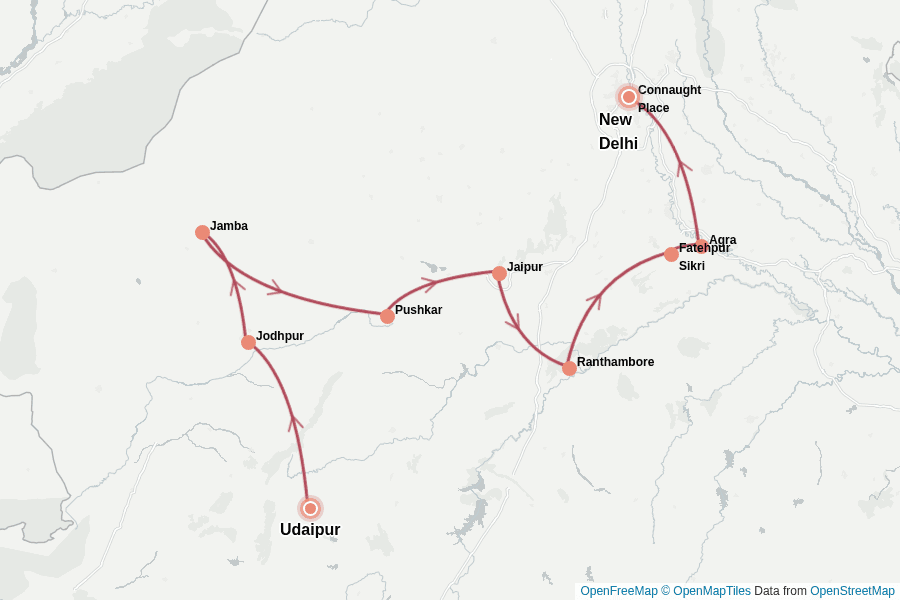
Most North India itineraries begin in the capital, because that is where the flights land. Arriving jet-lagged into Delhi is a hard way to meet India. Starting instead in Udaipur, a lake city of palaces and haveli rooftops, gives you a gentler introduction and lets the trip build towards Delhi at the end, by which point you are ready for it.
In short
Days 1–2 — Udaipur. Havelis, a sunset over the lake, your first thali, and a day of flavours and quiet courtyards.
Day 3 — Ranakpur. The marble Jain temple, miniature painting, and the road north.
Day 4 — Jodhpur. The blue city, its alleyways and its fort above them.
Day 5 — the Thar. Out into the desert for an immersion with nomadic communities and an evening of traditional song.
Day 6 — Pushkar. The sacred lake, one of the few Brahma temples in India, and blessings at the ghats.
Day 7 — Jaipur. The Palace of Winds, the pink city, and — because India would not be India without it — an evening at a Bollywood cinema.
Day 8 — Ranthambore. A tiger reserve, and a safari among far more than tigers.
Days 9–10 — Agra. Fatehpur Sikri and its Mughal ghost city, then the Taj Mahal at sunrise, which is the only time to see it.
Days 11–13 — Delhi. Old and New, the food, the monuments, and a final day of shared meals and farewells.
%3Aformat(webp)%2Ftrip%2F986e8d7d-e396-4c5e-94ca-cc9bfd167a9a-galle-fort-01.jpg&w=1920&q=75)
It is not a photographer's flourish. It is the difference between an experience and a queue.
By mid-morning the Taj Mahal is crowded and the light is flat and white. At dawn the marble takes colour from the sky, the crowds are a fraction of what they will be by ten, and the temperature is bearable. It requires an early start, and nobody who has done it has ever complained about the alarm.
The same logic runs through the whole itinerary. Fatehpur Sikri the day before means you arrive at Agra with the Mughal story already in place. Ranthambore the day before that means the wildlife is not an afterthought bolted on at the end.
Order matters in India more than in most places, because everything is more crowded and hotter later in the day.
%3Aformat(webp)%2Fpage_builder%2Fc0a83ad3-0e54-4592-ad76-3be1987dd735-kar_canva_stupa-in-anuradhapura-sri-lanka.png&w=1920&q=75)
Two things to weigh before booking, and we would rather you weighed them now.
The heat. Rajasthan is a desert state. From April the temperatures become genuinely punishing, which is why our departures avoid the worst of it. Even in the cooler months, days are hot and forts are approached upwards, in the sun. If heat is difficult for you, this is a trip to take in the winter months and to discuss with a specialist first.
The intensity. India is loud, crowded, brilliant and relentless, and first-time visitors are frequently overwhelmed on day two. That is normal. It is also why the route starts in Udaipur, why there are quiet days built in, and why a small group with a guide who knows how to read the situation makes such a difference.
Physically the trip is moderate: several hours on your feet at forts and palaces, steps and uneven ground, no trekking, and your luggage carried for you.
%3Aformat(webp)%2Fday_detail%2F5dce0073-d6c4-402c-93d6-d04bae3ecaa6-galle-fort-01.jpg&w=1920&q=75)
Varanasi. The holiest city on the Ganges sits east of this route and needs its own days.
Kerala and the south. An entirely different India — greener, gentler, and a separate trip.
Jaisalmer. The golden fort city in the far west. We reach the Thar desert without the long westward detour it would require.
A long stay at any one place. This is a moving itinerary. Two nights is the maximum in most towns.
If one of those is your reason for going, say so early and we will tell you honestly whether to extend, or to take a different trip.
%3Aformat(webp)%2Fe2bb4d75-c0a9-4d02-9c00-5ff2250680c1-mariana-proenca-5o3odxrqcfi-unsplash.jpg&w=1920&q=75)
The tour is land-only, so you choose the international flights that suit you; we publish recommended routes, airlines and timings for this tour. Note that it flies into Udaipur and home from Delhi, so book it as a multi-city ticket rather than a return. It runs on guaranteed departures and goes ahead regardless of numbers.
A maximum of 12 travellers, an English-speaking Karmaventura guide throughout, plus local guides at particular sites. Daily breakfast is included with further meals as set out in the itinerary; accommodation is in double rooms as standard, with twin or single rooms on request.
UK citizens need an e-Visa for India — applied for online, with a fee, at least a week before departure. Requirements change, so check the current position before you travel.
This route suits travellers who want the classic Rajasthan and Mughal circuit done properly, in a small group, with someone else handling the logistics — and who would rather see the Taj at dawn than at eleven o'clock with everybody else.
It suits less well anyone looking for a slow, single-base holiday, or travelling in the hottest months.
Our guide to how many days you need in India goes further into the length question. If you are still weighing it up, tell a specialist what you most want to see and they will tell you straight whether this is the trip.
Contact us
We’d love to hear from you. Please fill out this form.
All fields marked with (*) are mandatory.
%3Aformat(webp)%2F1ddf6816-60c9-4412-9f83-24c14d506ea8-copy-of-karmaventrua-logo-1200px-full-color.png&w=1920&q=75)
%3Aformat(webp)%2Fimg%2F2048x1536%2F314602.jpg&w=1920&q=75)
%3Aformat(webp)%2Fprofile-picture%2Fb8394f09-f31c-406f-a7f6-8fb1e5cb7605-c5abd1bb-9529-4e6d-a3c9-70d76d7b22c0-A98F549B-D93F-4A84-BF5D-875FDB63DC48.jpg&w=1920&q=75)
%3Aformat(webp)%2Fprofile-picture%2Fbfaa800a-2fe3-4118-90d8-870f539efa55-c5abd1bb-9529-4e6d-a3c9-70d76d7b22c0-8F49F972-2F02-4EB1-821C-E41F00FB1DC0.jpg&w=1920&q=75)
%3Aformat(webp)%2Fprofile-picture%2F2d1f2429-a2b1-45f9-8faa-dc14c1279a8d-c5abd1bb-9529-4e6d-a3c9-70d76d7b22c0-A00A80C6-21C7-4278-9841-9598CC2EE083.jpg&w=1920&q=75)
%3Aformat(webp)%2Fprofile-picture%2F8505f132-25a7-4d22-8ae9-8c2fcbd5b5ea-c5abd1bb-9529-4e6d-a3c9-70d76d7b22c0-9C1D5D2A-B987-47B4-9D6B-6CA41408B5CF.jpg&w=1920&q=75)
%3Aformat(webp)%2Ftravel_report_photo%2F96991%2F01d0f7bf-2b64-4361-a2a1-97f6b43ea047-6F74A829-BC07-4B75-A463-5ED7C32DFCDA.jpeg&w=1920&q=75)
%3Aformat(webp)%2Fprofile-picture%2Fbc89e157-fec4-4067-ae77-e2029008878a-c5abd1bb-9529-4e6d-a3c9-70d76d7b22c0-5272E335-FC8C-465D-9B77-55CD73F8EF57.jpg&w=1920&q=75)
%3Aformat(webp)%2Fprofile-picture%2F084eff53-4bf9-4f0c-a8b6-e61962b287c3-c5abd1bb-9529-4e6d-a3c9-70d76d7b22c0-E09A1B85-A0FC-4DB4-9DF6-743DC77F3B3E.jpg&w=1920&q=75)
%3Aformat(webp)%2Fcsat%2Ff2b14524-7973-4de9-ac3f-5a36fd37dfdd-screenshot-2025-10-28-185321.png&w=1920&q=75)
%3Aformat(webp)%2Fheader_media%2Fdef512ae-3143-45c0-8725-af55551b750b-taj-mahal.jpg&w=1920&q=75)
%3Aformat(webp)%2Fpage_builder%2F3d982d30-a7b8-4996-b8e1-a1a84d6b0b58-result_pexels-rubenstein111rebello-15693783.jpg&w=1920&q=75)